by Dennis Petersen

I wanted to write a personal little Christmas letter to all four of my dear kids and 10 grandkids.
Would you agree that Christmas ought to be far more exciting than the ‘tinsel-town’ fluff that’s typically merchandized so heavily in our desensitized, fast-paced society?
I wanted my own kids to get this clearly so they’d be able to help my grandkids to personally know the One for whom the original Santa Claus sacrificed his life… but you all might like to use it yourselves in sharing this Christmas season in a life-changing way with your own family. You could even gather your little ones around you to read this short review of how we got some of our Christmas traditions.
Today’s Western world is so monopolized by highly marketed big business and the secularized ‘lame-stream’ media that it’s completely understandable how the true origins of Christmas and many of its colorful traditions have been stolen and even hijacked.
It almost looks like Jesus has been completely replaced by a secularized Santa Claus.
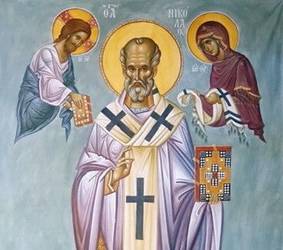

Maybe we could tell our kids about the original Saint Nicolas – the one who really lived 16 centuries ago – who became the source of the modern ‘Santa Claus’ myths.
He was a dedicated Christian. He was generous to the poor. That was the inspiration for Santa Claus.
If you want to discover the Greek traditional story about Saint Nicolas check out historian, Bill Federer’s excellent summary at this link… https://www.fggam.org/2019/12/american-minute-with-bill-federer-saint-nicholas-the-origins-of-secret-gift-giving/ Or just web-search “How Santa Came to the West – Bill Federer.”
You’ll find out where the name “Kris Kringle” came from.
You’ll see why Saint Nick returns every year to check up on God’s children and why he has a book listing their names as ‘naughty or nice.’
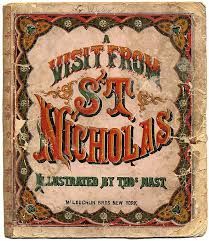
The modern make-believe fable of Santa began only 5 or 6 generations ago, in 1823. Would you believe that? It began with the publishing of a children’s poem called “A Visit from Saint Nicolas.” It’s pretty familiar to many English-speaking people today.
Though many additions have been added on, there really was a godly, courageous man who became a Bishop in the Christian church in 4th century in Asia Minor. His name was Nicholas. He loved Jesus enough to go into the ministry, but more than that, he was imprisoned for his faith by the Romans. He stood for the doctrine of the Trinity, and he preached against sexually immoral pagan temples, and was very generous, giving to the poor in their time of need!
Unfortunately, today’s media and Hollywood movie industry has “imagineered” a huge mythology of a secular Santa Claus that’s far more acceptable to secular humanists and atheists than the Lord Jesus Christ. Do you think maybe we should turn that around… at least within the areas of influence where we have an opportunity?
Have you ever tried Comparing Santa with Jesus?
If we do try to compare Santa with Jesus, there really will be no contest. So, why not help our kids and grandkids to spot the differences between cute and clever “make-believe” stories and real history – including the truths of the Bible? Let me just list a few little differences.
- Santa lives at the North Pole – Jesus left his celestial city to come to earth and commission His Holy Spirit to be everywhere with us.
- Santa rides in a sleigh – Jesus rides on the wind and walks on the water.
- Santa comes but once a year – Jesus is an ever-present help in times of need (daily).
- Santa may fill your stockings with toys – but think about it – Jesus can supply all your needs.
- You may have to stand in line to meet Santa – Jesus is as close as the mention of His Name.
- Santa may let you sit on his lap – but Jesus lets you rest in His everlasting arms.
- Santa has to ask you your name – Jesus not only knows your name, He knows your address too.
- He knows your past. He knows your future and He even knows how many hairs are on your head.
Some people have a problem understanding the reality of the Biblical truths about Jesus and the Holy Spirit… about God. And yet they just continue to perpetuate things that they know are absolute myths about a jolly old Saint Nick that are totally unreal.
- Santa has a belly like a bowl full of jelly – but Jesus has a heart full of love. Think of it…
- Santa says Ho, Ho, Ho! – Jesus offers Help, Hope and Heaven.
- Santa says you ‘better not cry’ – Jesus says ‘cast all your cares on Me for I care for you.’
- Santa needs little helpers to make toys – but Jesus? He, himself gives life, heals wounded hearts, repairs broken homes, and prepares eternal homes for us in Heaven… and so much more.
- Santa may make you chuckle, but Jesus gives you the joy of the Lord which gives you your strength.
- While Santa may put gifts under a tree – Jesus is the greatest Gift… and He gives us the gifts of the Holy Spirit.
So, why not Make This Your Best Christmas Ever?
Jesus really is the Reason for the season… and you know what? Wise men will seek Christ.
Give Christ your time, talents and treasure. Give Jesus your hands, and your feet… your lips, your heart… your whole life. Give Him your worship, your obedience, your sacrifice. Give Him your attention, and your adoration.
The Bible says to obey is better than sacrifice. So, make proper restitution when you have to. Be reconciled to your friends and your family. Be generous. Be grateful. Recognize the many outreach opportunities that are all around you to influence others for eternity.
Give God the very best that you have. Don’t waste your life and your time on the empty boxes of the world. And don’t settle for less than God’s very best. Jesus said it best in Matthew 6:33…
“Seek ye first the Kingdom of God and His righteousness and all these things shall be added unto you.” Matthew 6: 33
This season of this year, what an excellent opportunity we have to really talk about what matters in life. About the real Jesus. About the fact that He actually came into this world to save us from our justifiable judgment for our sin.
I want to thank my African missionary friend, Dr. Peter Hammond, in South Africa, for some of the ideas that I’ve shared with you in this time. You can see more of his excellent content at Disinformation About the Twelve Days of Christmas. You’ll find a wealth of information there.
In my letter to my kids, I wanted to write and tell them about some of these things. And I told them, in finishing my letter…
“I love you all more than I can express but remember that Jesus loves you infinitely more. He loved you enough to be judged and executed in your place. Love, Dad X o x o x o x o ++++++ and to all my dear friends… Love to you all from our house to yours at this wonderful season of remembering the turning point in the history of the world. Dennis”
And I wanted everybody to know about what Bill Federer had put together on his website.
Here is part of the text from Bill Federer’s article at this link: https://americanminute.com/blogs/todays-american-minute/saint-nicholas-the-origins-of-secret-gift-giving-american-minute-with-bill-federer .
So, How did Santa get to the West? Find out how Greek Traditions of St. Nicholas spread out to our world today.
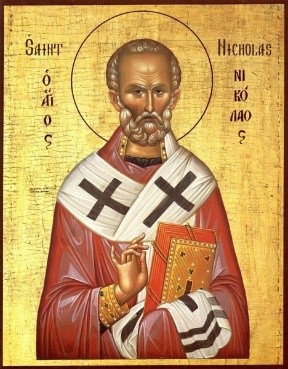
St. Nicholas is the most popular Greek Orthodox Saint. He’s almost equivalent to St. Peter in Roman Catholic tradition. Greek Orthodox traditions tell of Saint Nicholas being born around AD 280. He was the only child of a wealthy, elderly couple who lived in Patara, Asia Minor (present-day Turkey). When his parents died in a plague, Nicholas inherited their wealth. Nicholas generously gave to the poor, but he did it anonymously as he wanted the glory to go to God. I’d like to tell you about Nicolas and about some of the traditions that have arisen around his life.
Did you ever wonder what started the Christmas tradition of parents putting chocolate ‘gold’ coins in their children’s Christmas stockings hung on the fireplace mantle?
One notable incident from the life of Saint Nicholas was when a merchant in town had gone bankrupt. The creditors threatened to take, not only the merchants’ house and property, but also his children. The merchant had three daughters. He knew if they were taken it would probably mean a life of sex-trafficking, prostitution or forced marriages. The merchant had an idea of quickly marrying his daughters off so the creditors could not take them. Unfortunately, he didn’t have money for a dowry, which was needed in that area of the world in those times for a legally recognized wedding. Nicholas heard of the merchant’s dilemma and, late at night, he secretly threw a bag of gold coins through the window of the merchant’s house for the oldest daughter’s dowry. The bag of gold coins landed in a shoe or a stocking that was drying by the fireplace. It was the talk of the town when the first daughter got married.
Nicholas then threw another bag of gold coins through the window for the second daughter and she was able to get married. Upon secretly throwing gold in for the third daughter, the merchant ran outside and caught Nicholas. Nicholas made him promise not to tell where the money came from, as he wanted God alone to get the credit for the gift.
This story is what started the tradition of hanging stockings by the fireplace, not to mention the practice of giving secret gifts late at night on the anniversary of Saint Nicholas’ death, which was DECEMBER 6, 343 AD.
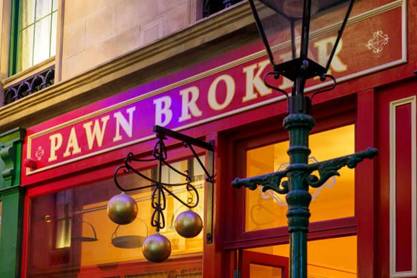
Have you ever seen the curious tradition in England where pawn shops display three gold balls hanging out front near the shop sign? The three bags of money which Nicholas threw into the house are remembered by those three gold balls. Why? Pawnbrokers like to present themselves as rescuing families in their time of financial need.
Nicholas made a pilgrimage to the Holy Land to visit the birthplace of Jesus. Mark Twain wrote a story about his travels to the holy land called “Innocents Abroad,” in 1869. He mentioned his visit to the Church of the Nativity in Bethlehem, long before modern tourists ever knew about it. He wrote of “This spot… where the very first ‘Merry Christmas!’ was uttered in all the world…” Mark Twain reminisced that it was from that place that… “…the friend of my childhood, Santa Claus, departed on his first journey, to gladden and continue to gladden roaring firesides on wintry mornings in many a distant land forever and forever.”
Nicholas considered joining a secluded monastery, till the Lord impressed upon him “not to hide his light under a bushel.”
Nicholas returned to Asia Minor where he became the Bishop of Myra, a busy Mediterranean port city on the south coast.
Soon, Nicholas was arrested and imprisoned during the Emperor Diocletian’s brutal persecution of Christians. He refused to deny his faith in Christ. Nicholas was eventually freed when Emperor Constantine ended Rome’s intermittent, three-century-long persecution of Christians.
When the first major heresy–the Arian Heresy–began to split the Christian Church, Constantine ordered all the bishops to go to Nicaea to settle it, which they did by writing the Nicene Creed. The tradition is that St. Nicholas attended the Council of Nicaea and was so upset at Arius for starting this heresy that he slapped him across the face. Evidently, Jolly Old St. Nick had a little temper!
Like the Apostle Paul in the Book of Acts, chapter 19, Nicholas preached against the sexual immorality of Artemis or Diana fertility worship. In fact, the Temple to Diana at Ephesus was one of the Seven Wonders of the Ancient World, twice as big as the Parthenon in Athens. It had 127 huge pillars–and temple prostitutes. It was the Las Vegas of the Mediterranean world in those days. Nicholas’ preaching led the people of Myra to tear down their local temple to Diana. Shortly after, from the preaching of St. John Chrysostom, Archbishop of Constantinople (AD 397-403), the people tore down the temple to Diana at Ephesus as well.
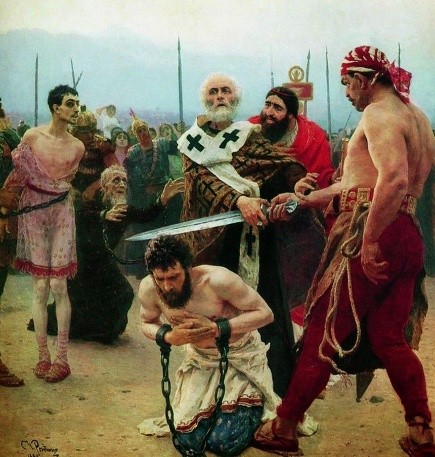
Nicholas confronted dishonest government politicians. One story was of a corrupt governor who was about to execute some innocent soldiers in order to cover up his misdeeds. Nicholas broke through the crowd, grabbed the executioner’s sword, threw it down and then exposed the governor’s evil plot. The Governor, realizing that Nicholas had no way of knowing his plot except by insight from God, fell on his knees and begged Nicholas to pray for him.
Greek Orthodox tradition attributes many miraculous answers to St. Nicholas’ prayers. Once a storm was so bad that fishermen and sailors were not able to get back to shore. The people asked Nicholas to pray and the sea became calm enough for the fishermen and sailors to return safely to port. This led to Nicholas being considered the patron saint of sailors.
Nicholas died DECEMBER 6, 343 AD. In the 5th century a church was built in Myra in his honor. It was damaged in an earthquake in AD 529, after which Emperor Justinian rebuilt it.
In 988, Vladimir the Great of Russia converted to Eastern Orthodox Christianity and adopted Nicholas as the Patron Saint of Russia.
I don’t know about you, but I had no idea that Nicolas had such a deep impact on so much of the Christian church in the early centuries after it began in Jerusalem on the Day of Pentecost.
In the 11th century, Muslim jihad terrorists, (the Seljuk Turks), invaded Asia Minor, killing Christians, destroying churches and digging up the bones of Christian saints and desecrating them. A Muslim edict back then (Hadith Sahih Muslim [Book 4, No. 2115] ) states: “Do not leave an image without obliterating it, or a high grave without leveling it.”
For protection, Christians shipped the remains of St. Nicholas to a church in the town of Bari in southern Italy in the year 1087. Pope Urban II dedicated that church, naming it after St. Nicholas–the Basilica di San Nicola, thus introducing this Greek St. Nicholas to Western Europe. So many Christians were fleeing the Muslim invasion of Eastern Europe that Pope Urban II went to the Council of Claremont in 1095 and called upon European leaders to send help. Help was sent –it was called the First Crusade. With St. Nicholas’ remains in Italy, western Europeans quickly embraced the gift-giving traditions associated with him.
So, How did St. Nicholas become Santa Claus?
By 1223, so much attention was being given to gift-giving during the Christmas season, that Saint Francis of Assisi wanted to refocus the attention to the birth of Christ. St. Francis created the first creche or nativity scene, a humble manger of farm animals with the focus being on Joseph, Mary and baby Jesus–the Son of God come to dwell among men. (It was first presented as a live enactment scene).
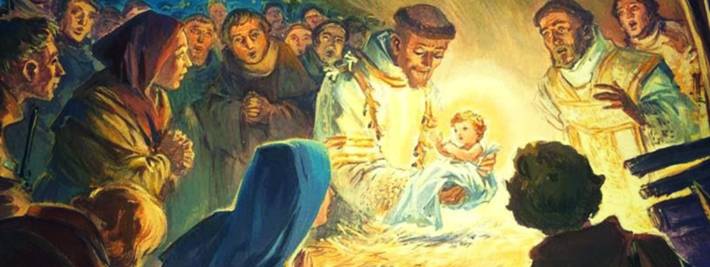
The First Creche at Greccio, Italy in AD1223
Saint Francis of Assisi, known for his deep devotion and connection to Christianity, sought to embody the essence of Christmas in a tangible form. He chose Greccio, a picturesque town in Italy, as the setting for his innovative depiction of the Nativity. This reenactment was not just a mere representation but an immersive experience meant to bridge the gap between the faithful and the sacred event of Jesus Christ’s birth.
Saint Francis’s Nativity scene was a humble yet profound display. Instead of grandeur and opulence, it featured simplicity and serenity, reflecting the humble circumstances of Jesus’ birth. This portrayal was a departure from the common artistic expressions of the time, which often focused on grandiosity. Saint Francis’s approach brought a sense of realism and relatability to the Nativity story.
From St Nicolas’ “Day” to December 25th
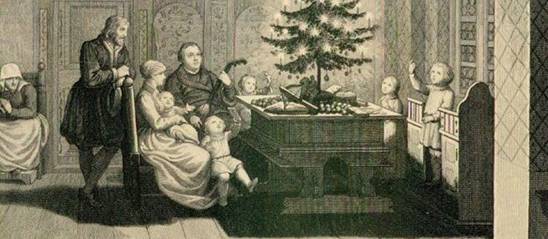
In 1517, Martin Luther began the Reformation. That, effectively ended the practice of celebrating “saints days” to commemorate individual early Christians, many of whom had been martyred. These special holidays were considered “holy days” but protestants decided they were distractions from Christ. Of course, that necessarily included discontinuing the celebration of the popular “St. Nicholas Day.” But, since Martin Luther’s Germany liked the gift-giving tradition, Martin Luther moved the giving to December 25th to emphasize that all gifts come from the Christ Child. And at that time, December 25th was considered to be the birthday of Jesus.
By the way, the German pronunciation of Christ Child was “Christ kindl,” which over the centuries became pronounced as “Kris Kringle.”
A Greek Orthodox tradition, developed about Jesus, riding a white horse, and the saints returning with him, on white horses.
You can read all about it in Revelation 19:11-16
“And I saw heaven opened, and behold a white horse; and he that sat upon him was called Faithful and True, and in righteousness he doth judge and make war. His eyes were as a flame of fire, and on his head were many crowns; and he had a name written, that no man knew, but he himself. And he was clothed with a vesture dipped in blood: and his name is called The Word of God … And out of his mouth goeth a sharp sword, that with it he should smite the nations: and he shall rule them with a rod of iron: and he treadeth the winepress of the fierceness and wrath of Almighty God. And he hath on his vesture and on his thigh a name written, King Of Kings, And Lord Of Lords.”
Revelation 19:14 added: “… And the armies which were in heaven followed him upon white horses, clothed in fine linen, white and clean.”
Since St. Nicholas is a saint, the reasoning back then was that he would certainly be one of the multitude returning with Jesus, riding a white horse. The medieval Greeks just embellished it a little with St. Nicholas coming back once a year for a sort of mini pre-Judgement Day, to check up on the children to see if they are on the right track. Over the centuries, the story evolved. In Norway there were no horses, so they have St. Nicholas riding a reindeer. The Saints came down from heaven, the New Jerusalem, the Celestial City–which turned into the North Pole, naturally. The Lamb’s Book of Life and the Book of Works turned into the Book of the “naughty and nice.” The angels turned into elves.
Curiously, during Henry VIII’s reign, Christmas celebrations in England became sort of a Mardi Gras–a time of partying and carousing. Of course, when Puritans took over England, they outlawed Christmas as too worldly. When Puritans settled in Massachusetts, in the New World, they had a five shilling fine for anyone caught celebrating Christmas. Colonial Puritan pastor, Cotton Mather (1663-1728), told his congregation, December 25, 1712:
“Can you in your Conscience think, that our Holy Savior is honored, by Mad Mirth, by long Eating, by hard Drinking, by lewd Gaming, by rude Reveling; by a Mass fit for none but a Saturn or a Bacchus, or the Night of a Mahometan Ramadan? You cannot possibly think so!”
But the Dutch settlers in America loved Christmas and St. Nicholas traditions. The Dutch had St. Nicholas coming once a year to give presents to good children, and guess who accompanied him? It was a Moorish costumed helper, named Zwarte Piet, who would put naughty children into gunny sacks to take back to Spain where they would be sold into Muslim slavery. Eventually, Dutch immigrants brought St. Nicholas traditions to New Amsterdam, which became New York in 1665. Dutch people pronounced Saint Nicholas as “Sinter Klass” or “Sant Nikolaus,” which became pronounced “Santa Claus.”
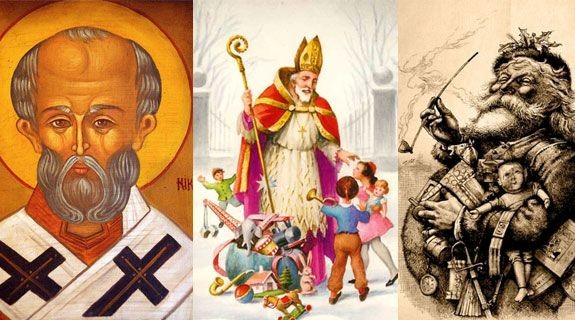
19th century novelist, Washington Irving, was the author of the Legend of Sleepy Hallow and Rip Van Winkle. Irving also wrote Diedrich Knickerbocker’s, “A History of New York” in 1809. In it he described St. Nicholas no longer wearing a bishop’s outfit, but a typical Dutch outfit of long-trunk hose, leather belt, boots and a stocking hat.
Clement Moore was an Episcopal priest and Hebrew professor at General Theological Seminary of the Protestant Episcopal Church in New York City. His family’s land is now the New York neighborhood of Chelsea, where a Clement Clarke Moore Park is located at 10th Ave. and 22nd St. In 1823, Clement Moore wrote a poem for his six children titled “A Visit From St. Nicholas.” Most every American today has probably heard it, maybe even more than the Bible story of the birth of Jesus in Luke’s gospel.
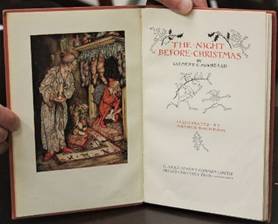
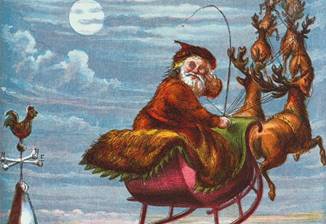
‘TWAS the night before Christmas, when all through the house Not a creature was stirring, not even a mouse; The stockings were hung by the chimney with care, In hopes that ST. NICHOLAS soon would be there …”
“When, what to my wondering eyes should appear, But a miniature sleigh, and eight tiny reindeer,
Clement Moore described St. Nicholas as smaller:
“He was chubby and plump, a right jolly old elf, And I laughed when I saw him, in spite of myself.”
The poem ends with a few phrases that say…
With a little old driver, so lively and quick, I knew in a moment it must be ST. NICK …”
“So up to the house-top the coursers they flew, With the sleigh full of Toys, and ST. NICHOLAS too …”
“As I drew in my head, and was turning around, Down the chimney ST. NICHOLAS came with a bound …”
Well, there’s no doubt that the image of Saint Nicolas was given a complete “make-over” that has lasted for generations now. In fact, after that poem was published, we could say that the real historic Christian man named Nicolas was obscured just about as badly as the Biblical Noah, by the early post-flood cultures.
Harper’s Weekly Magazine had an illustrator named Thomas Nast who drew St. Nicholas visiting Union troops during the Civil War. Nast, who was famous for inventing the Republican elephant and Democrat mule in his political cartoons, was the first artist to put a “North Pole” sign behind St. Nick as a subtle jab against the South during the Civil War.
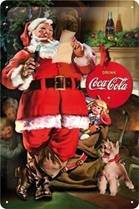
In 1930, Coca Cola hired artist Haddon Sundblom, famous for his Quaker Oats man, to create a painting every year of “Jolly Old St. Nick” drinking Coke.
Though many additions have been added on, there really was a godly, courageous Bishop in 4th century Asia Minor named Nicholas:
He loved Jesus enough to sacrifice his earthly possessions and give his life to full time Christian service.
He loved Jesus enough to be imprisoned for his faith by the Romans,
He stood for the doctrine of the Trinity,
He preached against sexually immoral pagan temples, and was very generous, giving to the poor in their time of need!
Well, you can read more about Clement Moore and Saint Nicolas and all these traditions that help us know why our modern generation has come to adopt a lot of the festive and colorful ideas about Christmas. But in the process, make this a time of talking with your family about the real meaning of Christmas.
Think about the prophecy of Zacharias, father of Jesus’ cousin, John, in Luke 2. Filled with the Holy Spirit, he prophesied to the baby John, just a few months before that memorable day in Bethlehem… “…you will go before the Lord to prepare his ways; to give his people the knowledge of salvation by the forgiveness of their sins, because of the tender mercy of our God, with which the sunrise from on high shall visit us, to shine upon those who sit in darkness and the shadow of death to guide our feet into the way of peace.”
And I hope that Jesus Christ will be the center of attention… not only in your hearts at this Christmas time, but also in your celebrations.
Reference… Read more at Bill Federer’s website AmericanMinute.com. See Bill Federer’s American Minute transcript at