
Have you ever had a conversation with someone expressing doubts about the credibility of the Bible? This is the question that God used to nudge me into being open to His assignment for what I thought was a ‘mission impossible.’ It literally changed the course of my life. Let me explain.
I was the father of three children at age 37. My wife and I had not yet moved into the house that we were building in the rural countryside of our new hometown in the mountains of northern California. It was three years after we had relocated from Canada, where I attended, and then taught, at a Bible college for 7 years before pastoring a small rural Canadian church for a few years. I had been working as a teaching pastor for a growing church for a couple of years at the time. I was hard at work every day building the house with a couple of hired carpenter friends I knew from our church.
One day, after all the framing was up for the house, while getting ready to put in all the plumbing and electrical fittings, before the sheetrock (plaster board) was even ordered, I was talking with a college-age young man working for us. I didn’t really know him very well. In light conversation about God and the Bible, he just happened to say something that God used to literally convince me that God wanted me to give my full-time attention and work to what I’ve been doing now for over 40 years.
He said to me something like this: “How can I believe the Bible if God couldn’t even get it right on the first page?” And you probably know what he was getting at when he asked me that perfectly honest question. Like most of the rest of us, that young man grew up going to public school. And in the late 70s and early 80s, public school was changing rapidly from what it was when I was in school in the 50s and early 60s.
Modern American education, just like everywhere else in the world, particularly in the areas of science, history, and philosophy, was liberally saturated with the teaching of “Darwinian Evolution.” Millions and billions of years was all that most everyone had ever even heard about. The idea of biblical creation, and especially a relatively recent creation, was unheard of for most public-school students. And the idea that God created the whole creation in six literal days?? That was considered by most people as just a religious fable.
Praying about that over the next several weeks and months, the Lord began to direct my steps in ways I would never have imagined. After working in several museums during my college career, and earning a Master’s degree in Museum administration, I worked as a history museum curator, building exhibits, cataloging artifacts, and heading up a growing museum community support group, as well as helping develop a new museum master plan. At the start of those four years, when I taught for the Bible college in Canada, I was given the assignment to develop a brand-new curriculum for a year-long course about The Bible and Science. After that, I presented multi-media lectures in several churches on some of the different topics in the course. There’s a common question that repeatedly came up, and I expect will always be a natural point of curiosity for any generation that’s exposed to evolutionistic thinking in contrast to the Genesis narrative.
How long were the days of creation? You might wonder why some people would even ask that question after reading the first chapter of Genesis. Each of the first six days described there is clearly separated by the phrase, “the evening and the morning were the first day… second day…” and so on.^ Those descriptive boundaries certainly make sense to us. Is there any reason to suspect it wouldn’t have been quite clear to Moses as well? But what is the condition that makes an evening and a morning? You might say “the sun.” But on day one the sun wasn’t created yet. And reading the text of Genesis, we discover that God didn’t create the sun until the fourth day along with all the other stars. Here’s a question for you. Even without a sun, how would you determine the length of a day? Is it not by the rotation of the earth? If you were on another planet the length of your “day” would be determined by the rotation speed of your planet, right?
Of course, with only a modest knowledge of Bible history, the implication of this idea would lead any reader to very naturally conclude that God said “let there be light” for the very first time only about six or 7,000 years ago. Well, that’s quite a thought. But, some find this far too implausible. But why? Is it because of their pre-conceived idea that the universe must surely be much older than that? If that’s the only kind of information about earth’s ancient history you were ever taught, well then naturally we would expect that kind of reaction. But, to follow it up, if they’re trying to show agreement with the Bible, you might hear them ask: “Isn’t there some place in the Bible where a day is described as a thousand years long?” Do you suppose they might be thinking they have to find a way to help the Bible get itself out of trouble with its credibility?

In the Apostle Peter’s second epistle in the New Testament, we find:
“Beloved, be not ignorant of this one thing, that one day is with the Lord, as a thousand years, and a thousand years as one day.” 2 Peter 3:8
Does Peter say a thousand years is only a day long? Of course not! And notice he’s saying “with the Lord.” And what’s the context here? If you examine that passage closely, you’ll notice that Peter’s talking about judgment to come! Clearly, Peter is driving home God’s patience with mankind and His over-arching presence outside the limits of time.^ One thing is for sure… he’s not declaring the length of the six days of the creation week in Genesis chapter one, is he?
So, does God’s Word anywhere give us some idea of the length of the Genesis days of creation?
Actually, it’s in Exodus chapter 20. You probably know that passage. It’s when God is thundering the Ten Commandments out loud for all the Israelites to hear God with their own ears at Mount Sinai. It’s quite a scene when you think about it. In verse eight He says, “Remember the Sabbath day, to keep it holy.” Now, why should we do that? Going on, He gives us the basis for the commandment.
“Six days shalt thou labor and do all thy work.” (the Hebrew word for day here is “yom”) Exodus 20:9
But Why would God make such a big deal about man limiting his work week to six days? Well, thankfully, He gives us a plain and straightforward answer. He goes on, saying…
“For in six days (the same Hebrew root word, “yom”) the Lord made heaven and earth, the sea, and all that is in them…” Exodus 20:11^
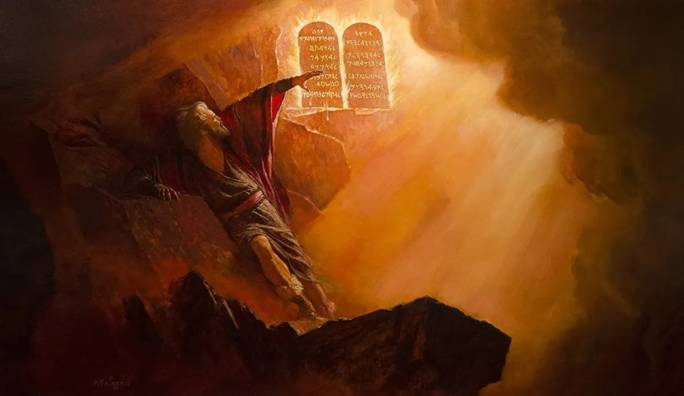
Figure 2 Giving of the Law painting by Arnold Friberg (1913-2010) commissioned by Cecil DeMille in 1953 for the movie The Ten Commandments (a series of concept art)
Do you think God could do all that in six normal solar days?
Let’s face it. He could have done it in six seconds if He wanted to. But He says He did it in six days! Could our trouble be in not fully understanding God’s all-mighty power?^ Has our generation reduced the concept of the Almighty Creator to something far less than what the Bible describes?
THINK! If one of those days God is talking about here really is a thousand years long, have we ever got a long work-week before Saturday comes!
Before we try to fit biblical creation days into any theory requiring long ages for Earth’s gradual evolution, we better take a serious look at the problems caused by such an attempt… that is, problems with the biblical text. God’s revelation is clear. He makes it impossible for us to make His Genesis declaration accommodate any evolutionist speculations. Think of it…
According to the Bible:^
- The Earth existed before all the trillions of stars!
- Daylight existed before the sun.
Now, just looking at those first two on the list, do you kinda think that’s diametrically opposed to any evolutionistic concepts that natural man thinks about trying to explain the beginning of the universe. Going on, if you look into the list, according to the Bible…
- Water covered the earth before the dry land ever appeared.
In other words it was all water? And then the dry land? Now, if you think about it, how does the evolutionist picture the beginning of our earth? It certainly wasn’t starting with water was it? No, it started out as some kind of a hot rock that was cooling off from a molten state, and then somehow water showed up… God know how! But that’s the whole point. God had nothing to say about that in His account of what He did at the beginning of creation. Now, another thing on the list…
- Complex fruit trees existed before jellyfish.
That means that advanced things that grew on the land before some supposedly simple kind of sea creature evolved. Wow… that’s totally opposite from anything you’d read in any evolutionary explanation about the beginnings of life on this planet.
Well, reading on into this list, it says that…
- All plants existed before the sun.
Do you have a problem with that? If God knew what He was doing He’d have to have a sun there because that’s how you generate photosynthesis in plants… Now wait just a minute… God is the One who created it in the first place… and He seems to be deliberately disrupting any kind of a plan that would be just opposite where you have the sun created after He created plants on the earth.
- Birds and whales existed before all land creatures.
How different is that from any evolutionistic idea about the evolution of life on earth? If you try to mix God into that equation it just doesn’t work. And then the last thing on the list is …
- Man was made before woman!
The Genesis account simply cannot fit with the evolutionist’s time line.
But what about all those stars that are millions of light years away?

Good question. The reasoning goes that in order for us to see the stars, whose light supposedly took millions of years to get here (at the present speed of light), the stars themselves must have been there for millions of years. Right? Well, let’s think a minute.
Why did God create the stars in the first place?
Remember they are there for the benefit of those on the earth. They have divine purposes. So, did God have to wait for millions of years to achieve His purpose? The nearest stars to Earth are at least 3 and ½ light years away from the Earth by modern scientific reckoning.
THINK! If your God is powerful enough to create the stars themselves, do you think He might be able to make their light beams instantly appear on the earth? Could the light have been created to travel at infinitely faster speed when the creation was very good?
HOLD ON, someone may say: “But doesn’t that create a misleading …APPEARANCE OF AGE?”
Now THINK about it! How old was Adam when God created him? No matter what was his stage of physiological development at his moment of creation, Adam would have had some appearance of age… or, perhaps we should say, an appearance of maturity! In reality, God made Adam and Eve fully able to bear offspring and have dominion over the earth from the beginning. Why do we know this? Because God told them to be fruitful and multiply. So, obviously they had to be mature enough to conceive and bear children, Right?
And think about this…
Did God create seeds, seedlings, or fruit trees with mature fruit on them and seed in them? Read Genesis 1:11-12.
Solomon wisely observed:
“God has made everything beautiful in its time: also he has put eternity in their hearts, but even so, people cannot see the whole scope of God’s work from beginning to end. Ecclesiastes 3:11 ^
“By the word of the LORD the heavens were made, and by the breath of His mouth all their host… For He spoke, and it was done; he commanded, and it stood fast.” Psalm 33:6, 9 ^
Remember – one of the primary keys to unlocking the mysteries of God’s creation is to follow his Word that tells us to “TEST everything… and hold fast to what is good.”
The truth of the Bible’s six days of divine creation suffered an historic setback as the industrial revolution dawned on the world. Modern science was being increasingly affected by anti-biblical secularism. Various theological controversies emerged in the 1800s. Society increasingly regarded the early historical parts of the Bible more like myths. Western civilization’s historic reverence for the authority of Scripture began to be replaced by the idolatry of naturalism and evolutionism.
Most people don’t realize that the biggest name in evolution – Charles Darwin – was only able to theorize the long, slow process of multi-generational evolution of species because of one gift! It was a gift that, at that time, was a fringe speculation… the completely novel idea of “Deep Time.” It was suggested a generation ahead of Darwin and persuasively written into a book authored by another Charles… Charles Lyell. He was an atheistic English lawyer who, later in life, wrote that one of his life’s goals was to liberate the science of geology from the influence of Moses. Think of that! His 1830 two-volume book was titled “Principles of Geology.” And it gave Darwin just what he needed to concoct his anti-biblical speculations about the evolution of biological life.
With millions and billions of imaginary years of time, evolution became the dominant view in the study of earth and life sciences. Secular academic educators, going into the 20th century, popularized evolution in society so well that the idea of millions of years became the new standard for how to think about the world and the universe. Intellectual mainline Christian theologians and pastors became increasingly detached from the study of nature as it reflected God’s creation narrative and earth’s early history in Genesis. Adam and Eve and Noah’s Flood were described more like quaint myths instead of historical reality. The more liberal element among church leaders influenced most college-educated young people to reject the truthful authority of the Bible. By the 20th Century various theories were devised to accommodate naturalistic evolution with clever ideas to make people think you could squeeze millions of years into the Bible’s narrative of history as seen in the book of Genesis.
So, some people might ask you…
Is there a Gap of time in Genesis?
According to the “Gap Theory” a large chunk of unrecorded time, maybe millions of years, followed what is assumed to be the first completed creation described in verse one of Genesis One. This unwarranted insertion into scripture has only one purpose… it accommodates evolution’s millions of years. And many just assume that it’s legitimate, even though the scientific evidence is completely inadequate to support it.
The description, “without form and void” in Genesis 1:2 is taken to mean that the entire creation became ruined and destroyed prior to the virtual “re-creation” described through the rest of chapter one. The supposed destruction of the world at that time is said to have been the result of the fall of Satan. The theory says that the entire earth was filled with plants and animals, and that even a race of “pre-Adamic” men ruled the earth. Then, with Satan’s rebellion, darkness invaded the perfect earth and a completely made-up global flood destroyed everything.
The vast ages of evolution textbook’s geologic chart all happened during this imaginary time gap. The fossilized plants and animals of our earth’s rock layers are supposedly the remains of God’s originally perfect earth, destroyed prior to the six literal days of re-creation recorded in Genesis One.
Gap theory supporters say Genesis 1:28 is a hint. That’s where the King James Version says that God told our first grandparents to “be fruitful, multiply and replenish the earth…” They suppose that a destroyed civilization had to be replaced and the earth REFILLED with inhabitants. But the word “replenish” was used in the King James because the word “plenish” was not a word used to say “to fill.” Modern translations just use the word “fill” in Genesis 1 verse 28.
So, where did this idea originate?
Actually, it goes back to 1814. The young science of geology in Great Britain was entertaining new ideas about earth’s age and geology. Scottish theologian, Thomas Chalmers, proposed the “ruin-reconstruction” idea to supposedly make room for long ages of time in the book of Genesis. Evolutionist thoughts about extreme age for the earth and a universe that evolved through “deep time” were increasingly promoted. Public media and education heavily propagandized society with the idea that earth was millions of years old. The straightforward historical and orthodox view of the Genesis record was under fierce attack in academic dreamland.
The idea really gained wide acceptance after it appeared in the footnotes of the Scofield Reference Bible in 1917, published by Oxford University Press, and funded by wealthy British elites.
Now, we realize that there are many good, sincere Christian scholars—men and women called to serve God—who have accepted and taught the gap theory as true. Though several Bible passages are used to support the idea, with increasing public attention on the origins debate, the gap theory is no longer taken seriously by most conservative Christian scholars. Let’s be honest enough to realize that it is only a theory. We also need to recognize there are some genuine difficulties with it.
Analysis of Gap Theory Problems
As you analyze the problems raised by the gap theory, you’ll see things that challenge other compromising theories that deceptive influences… like evil forces in high places… have raised up to attack the integrity of God’s Word.
1. A major problem arises before you even get out of Genesis one. In verse 31, God saw ALL that He made and “behold, it was VERY GOOD.”
- What does “very good” mean? Had the earth been destroyed leaving billions of fossilized animals as evidence of the destructive judgment? Could such a world legitimately be called “very good?”
Was Adam created to walk over a virtual graveyard filled with all manner of life forms which God had created and subsequently destroyed? This brings up another problem.
2. When did death begin?
- According to the Bible, did death on this earth begin with some Satanically ruled race?
- Romans 5:12 plainly says: “…by one MAN sin entered into the WORLD, and death by sin…”
- First Corinthians15:21 clearly relates to Adam, the first man, and the only “first” man the Bible ever acknowledges. It says, “by a man came death.”
- Even those who believe the Gap theory admit that the first few verses of Genesis are clearly lacking a context of judgement and death.
- Keep in mind that the supposed flood of destruction following eons of time did not occur until the fall of Satan. The Bible shows that the “groaning and travailing in pain” of the animal kingdom is a result of the curse brought on by Adam. How then could animals have died for thousands of generations even before Satan’s fall?
That brings up another problem.
3. When DID Satan fall?
- We know that when Satan was created, he was good and without rebellion. When was Satan created?
- In Genesis 2:1 it says: “Thus the heavens and the earth were completed, and all their hosts.” Exodus 20:11 elaborates further: “…in six days the Lord made the heavens and the earth, the sea and all that is in them.” Other Bible contexts refer to the all-inclusiveness of the creation event. Nehemiah 9:6 is an example. Here it says: “Thou hast made the heavens, the heaven of heavens with all their host, the earth and all that is on it, the seas and all that is in them.”
- Some may say that such an idea doesn’t give a long enough existence for Satan before Adam’s creation. We simply have to ask the question: Is such a long time required Biblically?
- After all, how long after his creation did Adam disobey God by eating of the tree of knowledge of good and evil? Probably not a very long time at all. We know that all of Adam’s days totaled 930 years. His first commission was to be fruitful and multiply. Eve’s first child would no doubt have been conceived within just weeks or even a few days after her creation. [The Bible calls Eve the “mother of all” humans, and we also realize that “all (humans) have sinned…”]49 If Adam fell in sin in such a short time, do you think it’s possible that Satan also could have fallen in a relatively brief time after his creation?
- When God saw all He had made, was it ALL very good? If Satan had already fallen by the sixth day of creation was God just ignoring him in this statement? Did God really mean “everything I made is good except for Satan and his rebellious angels?”
All that we’re discussing today is from my book Unlocking the Mysteries of Creation. You can find my recorded seminar presentations of many parts of it on our YouTube channel that’s linked in the notes for today’s show at Reclaim Your Legacy com … Go to: https://www.youtube.com/@dennis.petersen
I have just a couple more things to say about the Gap Theory as we wrap up today’s discussion on what the Bible has to say about the Days of Creation in the book of Genesis. This is all going to be part of a 36 week home-school course for families that we’ll be talking more about here on Reclaiming Your Legacy.
It’s worth asking a thought provoking question…
4. Who did God create to be the dominator of this earth anyway? Does the Bible ever indicate that anyone else but Adam was specifically made to rule this earth?
- Genesis 1:26 says: “…Let us make man in our image…and let them rule…over all the earth.”
- Were there ever animals made by God (like Dinosaurs) over which Adam did not have dominion? Some suggest that Satan created some of the grotesque giants of the prehistoric past. But does Satan have the power to create life? Or is he the one ultimately responsible for the perversion of life? Does the Bible say anything about a demonically linked corruption of earth’s animal life?
5. And what about the Great Flood of Noah’s Time? Does the gap theory maximize the impact of a pre-creation week flood while minimizing the Biblically historical flood of Genesis?
Ending…
If you haven’t yet seen the seminars about the content of my book Unlocking the Mysteries of Creation, I invite you to check them out now at YouTube. You’ll find the link in the transcript for today’s show … or you can just go to YouTube and key in my name Dennis.Petersen.