As a lifelong student of the fascinating stories of America’s legendary heroes, from the Pilgrims to the Patriots, I discovered an interesting intersection with Holy Scripture. Just as the Bible has its notable heroes of faith and God-given courage in the eleventh chapter of the Book of Hebrews in the Bible, so also does the history of America have its heroes of courage and faith in its God-given deliverance from tyranny. And both have had their detractors and skeptics. They continually try to steer generations of young students away from confidence in the truthful place of those heros in the record of Almighty God’s providence in His redemption of the human race.

Accusations to disparage the Founding Fathers are common in the world of fallen mankind. You’ve likely heard slanderous assertions that the Founding Fathers were a bunch of atheists, agnostics, and deists wanting a strict separation of church and state – nothing less than a secular government and a secular public with barely any Biblical values. While their charges are shamefully false, no one is suggesting that all the early American leaders were devoted Christians (though most of them were). The vast majority of Founding Fathers wrote openly, and often, about the influence of Christianity, the Bible and Jesus on their personal lives. You can learn more of the faith journey of the people we’re talking about in the resources noted in the transcript for today’s podcast, but let’s hear some actual quotes to get a glimpse of the thinking of these men.

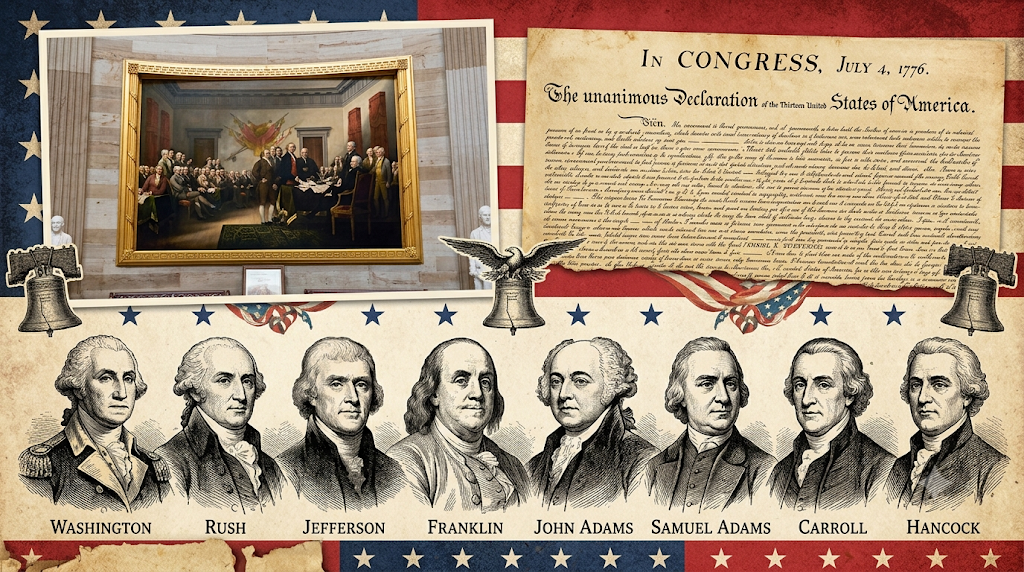
It’s now been over 250 years that the people of the American republic have enjoyed the blessings of being a free and self-governing nation. And it all began with the convictions of the Preamble of the Declaration of Independence. Have you heard those words lately? They were deeply believed by every single patriotic American in 1776. But, no matter how patriotic each one of us might sincerely think we are today, I have to humbly admit that there’s almost no way any of us today can fully grasp the sobering reality and risk those men faced.

Knowing what was written in that document, about to be made public the next day, John Adams wrote to his wife, Abigail that the date of the signing of the Declaration of Independence in July 1776 would become the most memorable date in American history. He expected it to be celebrated annually by future generations as a great anniversary festival and day of deliverance. He believed the holiday should be marked by solemn devotion to God and public festivities including pomp and parade, shows, games, sports, guns, bells, bonfires, and illuminations across the continent from this time forward forever more.

The devoutly Christian John Adams deeply believed that the founding generation of America sacrificed their prosperity, safety, and peace of mind deliberately for the purpose of establishing liberty in their land. Doing that was unquestionably a God-given blessing to his generation. But he also had a deep sense that there was a significant risk that unborn generations would take these privileges for granted. Adams feared that without a deep appreciation for the moral burden and hardships endured by his contemporaries, future Americans might fail to uphold the Constitution and the republican values they secured. He made it very clear that this sacrifice was not for any personal gain for any of the Founders. It was only to ensure that their sons and their descendants would have the liberty to pursue useful understanding of things like mathematics, philosophy, and the arts without the constant burden of war and political strife.

All 56 patriots who signed the Declaration took their duties so seriously to the people of the new nation that they made a promise “with a firm reliance on the protection of Divine Providence, we mutually pledge to each other our lives, our fortunes, and our sacred honor.” They signed the Declaration of Independence knowing that the penalty would be death if they were captured, and that pledge could literally cost them their lives and fortunes.

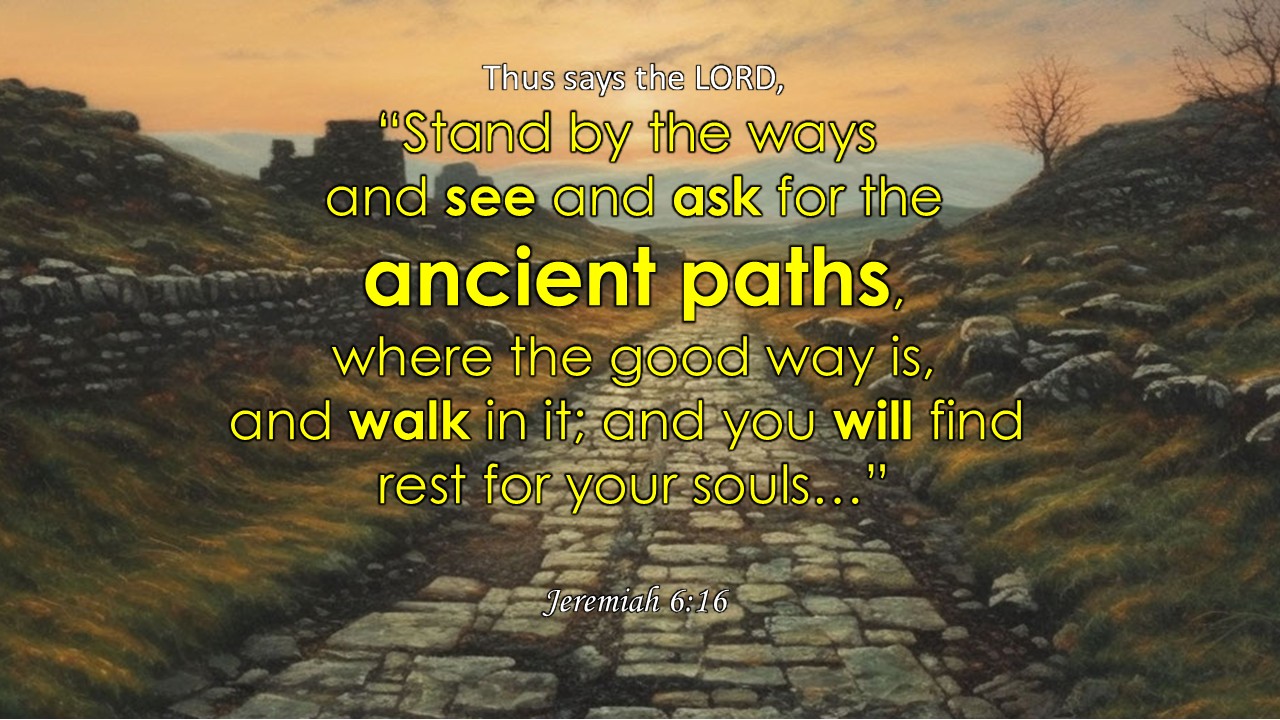
When God’s people recognize that the path of the society around them is collapsing, the prophets of the Bible give us an unmistakably clear assignment, if we’re willing to accept it… Be a generation called to rebuild the ancient paths.
The confusion and uncertainty assaulting humanity worldwide today is being identified by many as an all-out strategy of destructive warfare from the Enemy of mankind himself. So, what is the ‘assignment’ God has for His people in the middle of such alarming chaos?
The 58th chapter of the prophet Isaiah declares clearly, Almighty God’s displeasure with the superficial, self-centered, and hypocritically empty religious rituals of His people. Instead, He desires a deeper and personally more authentic form of worship, defined by distinctive actions. And biblical worship – let’s not miss it – is a sacrificially devoted spiritual life-style, not just a weekly religious exercise.

Many pastors who avoid debatable or political/social topics, claim they are ‘just called to preach the gospel.’ Others avoid contemporary arguments in society by sticking to their preaching and teaching schedule. These seem to be noble practices to most Christians, but do you think it’s only fair that those who sit down to dine at the table of where they get their spiritual food each week have a responsibility to humbly challenge their spiritual teachers to address controversial topics that are relevant to the issues we all struggle with that are going on in our world today?

The gospel Jesus preached demanded total surrender. He told people to count the cost (Luke 14:28). He said following Him might cost family, comfort, reputation, maybe even life itself (Luke 14:26-27). He never chased crowds by lowering the standard. When people walked away, he let them go. Contrast that with today’s approach. Churches compete for attendance. Sermons are shortened. Sin is renamed as struggle. Holiness is replaced with becoming religious, whatever that means. And the cross is softened into a mere icon of identification, or worse yet, to some, a symbol of good luck. But the gospel is not about self-improvement. It’s about self-crucifixion. Jesus said, “Why do you call me Lord, Lord, and do not do the things which I say?” Luke 6:46.

That question still echoes today. The gospel Jesus preached demanded total surrender. He told people to count the cost (Luke 14:28). He said following Him might cost family, comfort, reputation, maybe even life itself (Luke 14:26-27). He never chased crowds by lowering the standard. When people walked away, he let them go. Contrast that with today’s approach. Churches compete for attendance. Sermons are shortened. Sin is renamed as struggle. Holiness is replaced with becoming religious, whatever that means. And the cross is softened into a mere icon of identification, or worse yet, to some, a symbol of good luck. But the gospel is not about self-improvement. It’s about self-crucifixion. Jesus said, “If anyone desires to come after me, let him deny himself, take up his cross daily, and follow me.” Matthew 16:24-25.

How many Christians actually think of anything like that, when they put on their “Christian” jewelry to publicly show they are a blood-bought child of the living God?

Most of us in modern church traditions have been unknowingly influenced by much lack of knowledge of historical and cultural backgrounds. It’s unfortunate that many well-meaning evangelicals take such hard positions without being Bereans to “test all things” and realize we all suffer from a “lack of knowledge” in many areas. Our opinions must not be presented as ‘dogmas’ when careful diligence in research exposes glaring inconsistencies that can make our positions embarrassing.

New Testament believers actually continued celebrating Passover as a memorial of the redemption accomplished by Jesus in His death.

This divine foreshadowing is further shown during the Last Supper, where Jesus and his disciples were celebrating what we know as the “Passover Seder.” Jesus introduced a powerful new dimension to the historic Passover feast that Moses recorded in the book of Exodus. He explained profound meaning for the sacrifice of himself that he was about to endure, symbolizing his body and blood as the fulfilment of God’s new covenant (Matthew 26:26-28).

People commonly say the Bible flood is just a myth, a legend borrowed from ancient Mesopotamia, or just symbolic spiritual ideas. If that were true, wouldn’t you expect the story to dwindle away over time, rather than get stronger? But now, we actually have more evidence than ever, pointing to historic reality more amazing than any legend. And it’s not just from one or two isolated places, not from one culture. It’s from all over the world. When you start looking at ancient sites, things get uncomfortable fast for the skeptical atheist.

They’ve become so fed up with the modern paganization of Christmas in our society that they’ve stopped participating in Christmas celebrations, thinking of the possibility that some holiday traditions might have their roots in pagan customs. Their sincere hearts want to please God, so they’ve even given up on the idea of trying to “keep Christ in Christmas.” I certainly respect these sentiments, but as with so many things… especially the controversies of our generation… there’s nothing to be gained by allowing a lack of knowledge to destroy our family’s delight with the celebration of our Savior’s birth. The solution to the controversy… like with other controversies… is taking the time to be like the Bereans in the New Testament book of Acts (Acts 17:11) and “test all things” (1 Thes 5:21), searching the Scriptures and digging into history to see what’s true.