Have you ever been curious how the number 7 keeps popping up in the Bible?
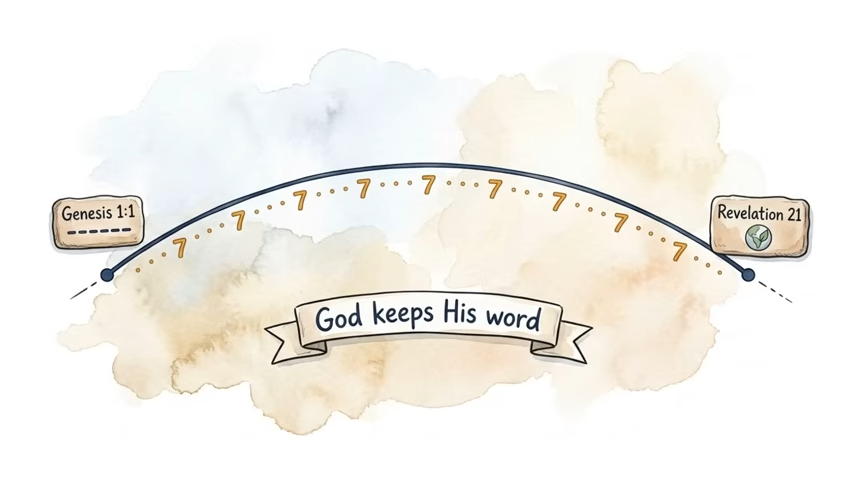
Over 700 times, the number 7 is prominently woven into many Bible passages … nobody can miss it! But it’s not there as some mystical formula or code. It’s much more powerful – a covenant signature. From the seven-word opening of Genesis to the final vision of Revelation, every appearance of 7 expresses the same unmistakable message – God keeps His word!
“The words of the Lord are pure words, like silver refined in a furnace on the ground, purified seven times.” Psalm 12.6 (NKJV)
This passage from Psalm 12 is packed with more personally relevant meaning than I ever imagined.
Did you happen to notice that the first sentence of the Bible is seven words long?
In Hebrew, the first 3 words are “Bereshit bara Elohim” … meaning “In the beginning God created.”
The last 3 words in Hebrew represent “the heavens and the earth.”
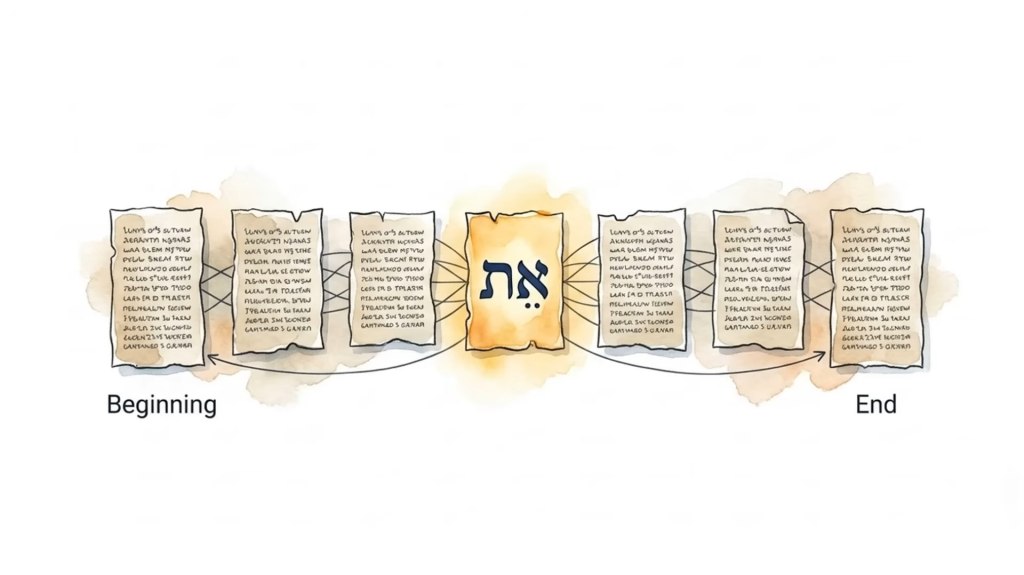
But there are 7 Hebrew words here. The middle word, the fourth one, is spelled with just two Hebrew letters, aleph and tav, the first and last …
…letters of the Hebrew alphabet. It’s untranslatable! Your English Bible doesn’t even show it’s there. But it’s at the very center of your Bible’s opening line, beside the word for God (Elohim)… quietly connecting beginning and end… like a signature.
God’s writers of Scripture were meticulous wordsmiths. This seven-word opening line for the first book of His Torah, called Beginnings (or Genesis)… begins a pattern that repeats across all the generations from Moses to John’s Apocalypse, in ways most readers have never noticed.
The number seven is not just a frequent word in the Bible. It’s a deliberate element of God’s architecture of divine meaning. It’s sewn into the language itself. When we track where it shows up and why, a unified idea keeps surfacing… God finishes what he starts. Follow that thread with me as we see the word itself.
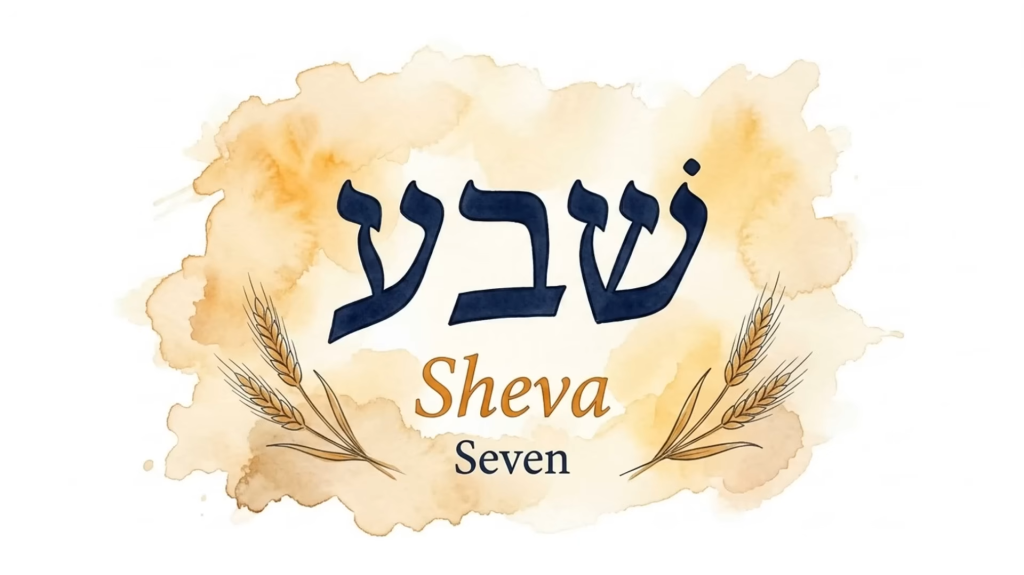
The Hebrew word for seven is Shev’a. The root for Sheva means to be full, to be complete, to be satisfied. Using the same consonants, that same root also produces the Hebrew verb, Sha’vah, meaning to swear an oath. In Hebrew… to swear and to seven have a remarkable association. I learned that these words show how ancient Hebrew minds understood promises. When they swore an oath, it was like binding yourself so completely that your commitment was utterly impossible to undo. Fullness and promise were the same concept conveyed by the same letters.
There’s a third word built from the same consonants… So’vah. It means satisfaction or having enough. Linguists debate about word connections, but ancient Hebrew ears undoubtedly heard the echo. Completion, oath, and deep satisfaction… all carried by the same three letters. No English number has such profound meaning behind it. This connection shows up in one of the oldest place names in the Bible.
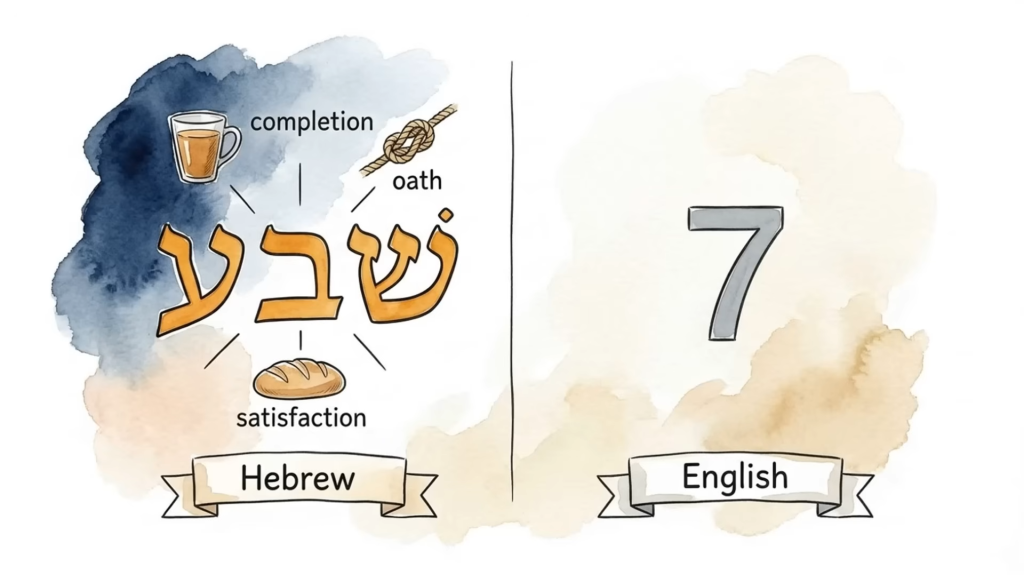
Remember when Abraham and Abimelech made a treaty at a well In Genesis 21? Abraham sets apart seven ewe lambs as a witness to the agreement (vs. 30). And the place was named Be’er She’vah (vs. 31), which mean both well of seven and well of the oath. The name literally carries both meanings together. Seven is the oath. The oath is seven. Notice how God’s letter to the Hebrew Christians describes this. God himself swore an oath to Abraham, by himself because there was no one greater to swear by; Hebrews 6:13. God not only invented the concept of the oath. He chose to bind himself by it.
Now think back to Genesis one. God created for 6 days and then stops creating. On the seventh day, he rests… (not because he’s tired. Isaiah 40:28 is clear on that – “The Creator of the ends of the earth neither faints nor is weary”)… because His work is complete.
The Hebrew word used in Genesis 2:2 is vay’ekhal, “and he finished His work.” It’s a declaration. Everything needed for life to flourish had been spoken into existence. Now the Creator rests on the seventh day… not from exhaustion… but from completion. Creator God then does something unique, not done for any other day. He blessed the seventh day. He set it apart… made it holy… sanctified it.
Genesis 2:3 uses the Hebrew word qa’dash, meaning to separate something from the ordinary and dedicate it to a sacred purpose. No other day gets this tag. The seventh day is memorialized as completely alone. This is the Bible’s first use of the concept of holiness. It’s attached to time, not to a place, not to an object, not to a person. Before there’s a temple or an altar or a priest, there’s a holy day, the seventh day. It’s unforgettable. The number seven and the idea of what is sacred are declared in the biblical story together in the same sentence.
You’ve probably noticed something else about the seventh day in Genesis. Days 1- 6 each end with the same description: “And there was evening and there was morning.” But the seventh day is missing the pattern. There’s no evening recorded for the seventh day.
It’s as if the text is saying, “The seventh day isn’t over yet.” And that idea that God’s completed rest is still available, echoes in the New Testament, where the writer of Hebrews declares, “There remains a Sabbath rest for the people of God” (Hebrews 4:9). From that point forward, seven keeps showing up in places you’d never expect.
Noah is charged to bring seven pairs of every clean animal into the ark (Genesis 7:2). After the floodwaters recede, he waits 7 days before sending out the dove a second time (Genesis 8:10). Then seven more days before sending it again (Genesis 8:12). The world is being remade and the rhythm of seven marks each stage of the process. Creation is being reset and the reset follows the same rhythm as the original. Jacob works seven years for Rachel, then seven more. His story of love and waiting and deception and perseverance moves in units of seven. And when he finally reconciles with his brother, Esau after decades of separation, he bows seven times before him (Genesis 33:3). The number marks the moment when a broken relationship reaches its resolution.
Think of when Joseph interprets Pharaoh’s dream. The structure is sevens isn’t it? Seven fat cows, seven thin cows, seven full ears of grain, seven empty ears, seven years of abundance, seven years of famine. The entire life of the ancient biblical world seems to revolve around cycles that God reveals in patterns of seven. And the one who correctly interprets the sevens is the one who saves nations from starvation. Think of Joseph. These are not literary decorations. The biblical writers embedded a pattern into the narrative. Whenever something reaches its intended fullness, whenever a process is brought to its designed conclusion, the number seven marks the moment. It’s the Bible’s way to tell us this is not random. This is by design and the design is complete.
And when God finally instructs Moses to build the portable sanctuary where God’s presence would dwell among his people, the tabernacle, one of the first items described is the lampstand, the menorah. With seven branches and seven lights, it was hammered from a single piece of gold (Exodus 25:31-37). That means it wasn’t assembled from separate parts. It was one continuous object shaped into seven. The light of God’s presence burning in the holiest space on earth was structured around the number of completion. Seven flames from one source giving complete light. The psalm writers continued this pattern.
Psalm 126 says, “The words of the Lord are pure words like silver refined in a furnace on the ground, purified seven times.” The number is deliberate! Complete purification! God’s word is not partially reliable. It’s been tested to the point of total purity. Seven is the psalmist’s way of saying, “There’s nothing left to remove. It’s fully trustworthy.”
But seven doesn’t mark only endings. It also marks beginnings that are themselves declarations of completion. The clearest example is the covenant system embedded in the law of Moses.
Leviticus 23 outlines seven annual appointed times that God established for His people, Israel. The Hebrew word is Mo’adim. Not five, not 10… Seven! Passover, unleavened bread, first fruits, weeks,
which is Pentecost, trumpets, the day of atonement, and tabernacles. Seven of them.
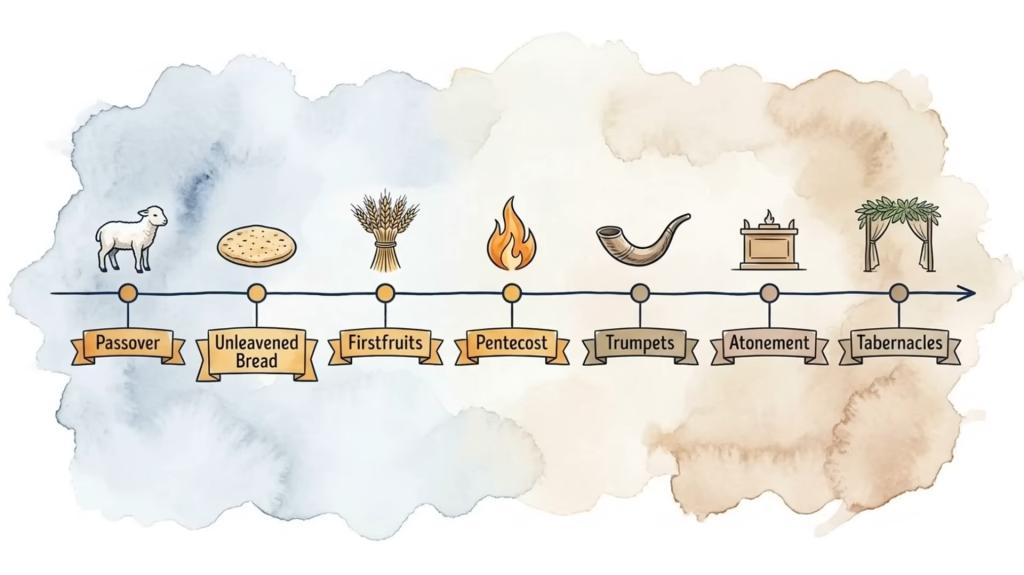
Seven sacred appointments are spread across the calendar year. The text is explicit! These are not Israel’s feasts. They are, as Leviticus says, the feasts of the Lord (Leviticus 23:2). The Hebrew word, Mo’adim, is often translated feasts, but it literally means appointed times. These aren’t parties. They’re scheduled encounters. God built a calendar and told his people, “Meet me here.” And he built it in sevens to tell a story. The first three are in the spring, clustered around the barley harvest. The last three fall in autumn, around the final harvest. And in the middle is Pentecost, marking the wheat harvest, holding the two groups together. Seven feasts, three, then one, then three, a symmetry that mirrors creation week itself. And you know what makes this extraordinary? The first four of these appointed times correspond to events in the life of Jesus that the gospel writers record with striking precision. Jesus was crucified on the very day of Passover. He was buried during unleavened bread. He rose on the very day of first fruits and the Holy Spirit came on the day of Pentecost 50 days later. Four of the seven appointed times were fulfilled on the exact days they were appointed, centuries after God established them through Moses.
That leaves three: trumpets, atonement, and tabernacles. God set up a calendar of seven and His calendar is being fulfilled. Not approximately… precisely.
But the sevens in the law go deeper than the annual calendar. Leviticus 25 introduces the sabbatical year. Every seventh year, the land was to rest. No plowing, no planting, no harvesting. Just as humans rested on the seventh day, the land itself was to experience a year of completion and restoration. The rhythm of seven was written not only into the week, but into the agricultural economy of an entire nation.
And then comes the most dramatic meaning of “sha’vah” of all. Count seven sabbatical cycles, 7 times 7 years, 49 years, and the 50th year becomes the Jubilee. The Hebrew word is Yo’vel. In the Jubilee, debts were canceled, slaves were freed, and land returned to its original owners. The Jubilee was a national restart built on the foundation of 7 times 7. It was the ultimate declaration that God’s economy is designed to move toward restoration, not permanent loss. Remember when Jesus stood in Nazareth’s synagogue and read from Isaiah 61? “The spirit of the Lord is upon me because he has anointed me to proclaim good news to the poor, to proclaim the year of the Lord’s favor” (Luke 4:18-19). Many scholars believe he was deliberately invoking the language of Jubilee, the year of the Lord’s favor, the great reset, God’s restoration built on sevens.
Now, step back for a moment. If someone asked you right now, what is the meaning of the number seven in the Bible? You can tell them this.
- It starts with the Hebrew language itself, where seven, oath, and satisfaction share the same root.
- It appears in creation, where the seventh day is the first thing God calls holy.
- It structures the weekly rhythm, the annual calendar, the 7-year agricultural cycle, and the 49-year jubilee.
- And each time it carries the same idea, completion that is bound to a promise. God isn’t just finishing things. He is finishing things he swore he would finish.
You might remember a turning point in the book of Joshua where the number seven emerges from its quiet background pattern directly into the foreground for all to see. The city of Jericho is on the horizon in Joshua 6. Two million Israelites have just crossed the Jordan River into the promised land. The walled city is their first major obstacle with gates shut tight. And what’s the battle plan God gives Joshua that no military strategist would ever design?
March around the city once a day for 6 days. Nobody talks. Seven priests carrying seven rams horn trumpets walked in front of the ark of the covenant, blowing the trumpets as they walked. On the seventh day, march around the city seven times. After the seventh circuit, the priests blow the trumpets. The people are ordered to shout… and the walls fall. Seven priests, seven trumpets, seven days, seven circuits on the seventh day. The text is saturated with sevens… and the effect is deliberate. This is not a military operation. It’s a spiritual declaration of disciplined obedience fulfilling a promise of the Lord of Hosts. The conquest of Jericho looks more like a temple dedication than a siege. And that’s the point. The fall of Jericho is not a story about Israel’s army. It’s a story about God completing what he promised. He told Abraham the land would belong to his descendants (Genesis 15:18). He told Moses he would bring them in (Exodus 6:8). And now at the walls of the first city, the method he chooses is designed to make one thing unmistakable. The completion belongs to Him.
Notice something else. The ark of the covenant is at the center of the procession. The ark represented God’s presence and his covenant promises. Israel did not lead with swords. They led with the most powerful weapon of their warfare – the presence of The Most High God … signified by the ark. The sevens in the story all point in the same direction. This is about God’s faithfulness reaching its conclusion, not about human strength forcing an outcome. And there’s another layer most people miss. God told Joshua before the march even began. See, I have given Jericho into your hand (Joshua 6:2). The verb is past tense. I have given, not I will give. Before a single step was taken, God declared the outcome as already accomplished. The 7-day march was not the cause of the victory. It was the process by which Israel aligned themselves with a completion that God had already decreed. Jericho involved an entire nation.
Remember the gentile Syrian Commander Naaman?
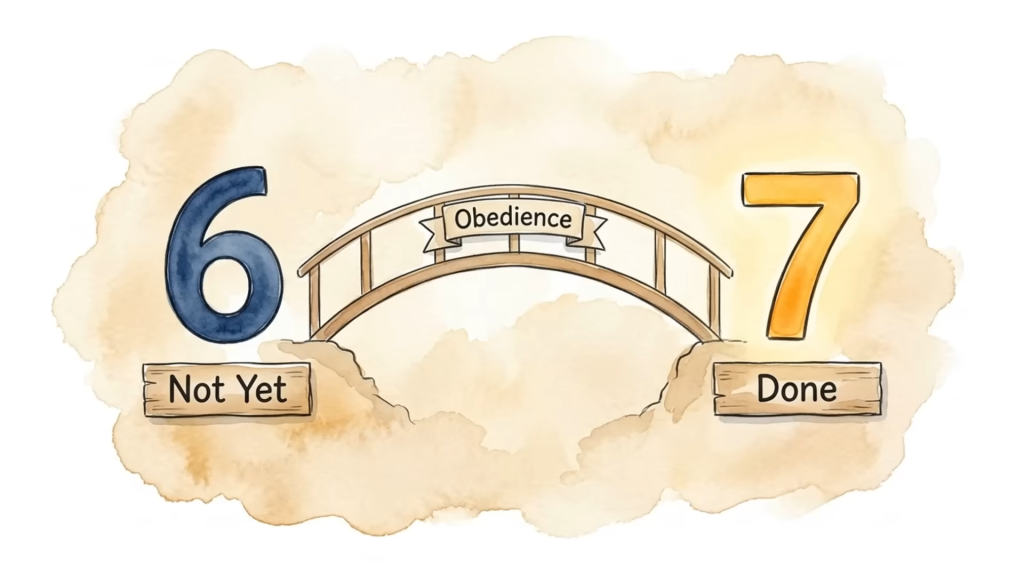
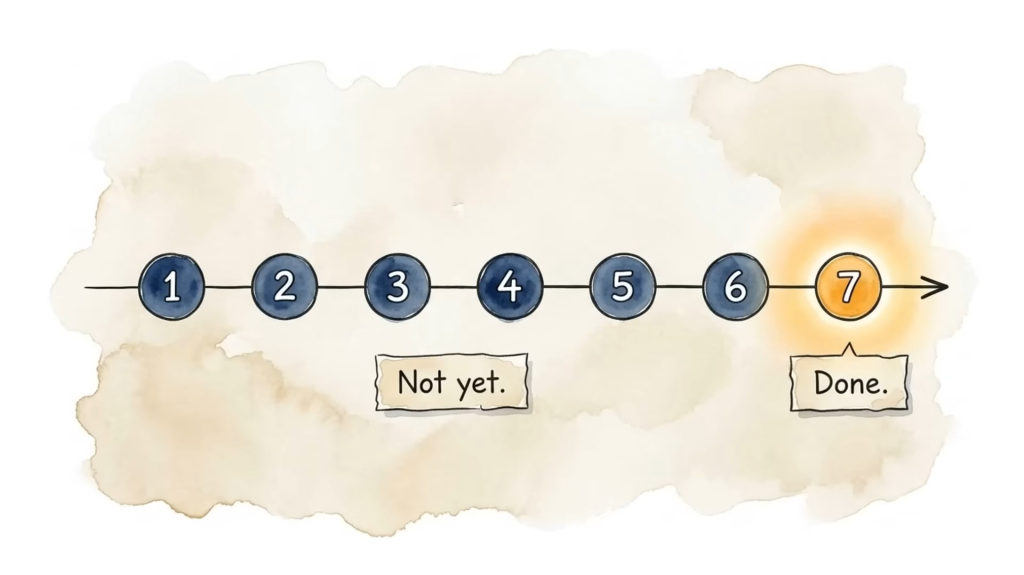
But the pattern of seven shows up just as powerfully in the life of a single person. When Elisha tells the Syrian commander Naaman to wash in the Jordan River, the instruction is to dip seven times (2 Kings 5:10). Not three, not five, so why seven? Naaman resists at first. He thinks a more impressive river than the Jordan would be worthy of his blessing. But the prophet insists, and after the seventh dip, his skin was restored like the flesh of a young boy (2 Kings 5:14). The pattern is the same. The seventh moment is the moment of completion. But there’s more in this story worth noticing. Naaman nearly walked away after hearing the prophet’s instructions. He thought the prescription was beneath him. If he had left after any dip short of the seventh, nothing would have changed. The difference between six and seven in the story is the difference between not yet and done. And only obedience bridged the gap.
The Prophet Daniel gives us more insight
Jump several centuries to the book of Daniel. Here’s where the number seven enters prophetic territory. Daniel is living in exile in Babylon. He’s been reading the prophet Jeremiah and realizes that the 70 years of captivity Jeremiah predicted are nearly complete (Daniel 9:2). So, he prays and in response, the angel Gabriel appears with a message that extends far beyond the return from Babylon. Gabriel tells Daniel that seventy 7s are decreed for his people and for the holy city (Daniel 9:24). The Hebrew is Shiv’im Shavu’im. 70 units of seven. The purpose of these seventy 7s according to the text is sweeping.
- To finish transgression,
- to put an end to sin,
- to atone for iniquity,
- to bring in everlasting righteousness,
- to seal up vision and prophecy, and
- to anoint the most holy (Daniel 9:24).
Six purposes, all of them pointing toward a decisive once-for-all resolution. And the timeline given for the arrival of Messiah the prince is embedded within these sevens (Daniel 9:25). The details of this prophecy have been interpreted in various ways across Jewish and Christian traditions. And the specific calculations are debated. But what is unmistakable is the framework. The timeline for the Messiah’s arrival and his atoning work is structured entirely in sevens. God is not using random numbers. He’s using the number that means oath, fullness, and completion. The very architecture of the prophecy declares this will be fulfilled completely.
Now, let’s cross into the New Testament and the sevens take on profound meaning. In the Gospel of John, Jesus makes seven statements that begin with the words, I am.
- I am the bread of life.
- I am the light of the world.
- I am the door.
- I am the good shepherd.
- I am the resurrection and the life.
- I am the way, the truth, and the life.
- I am the true vine.
Several of the declarations connect Jesus to Old Testament imagery.
- The bread echoes the manna in the wilderness.
- The light recalls the pillar of fire.
- The shepherd points to Psalm 23.
- The vine reaches back to Isaiah’s vineyard.
Together, those seven “I am’s” portray Jesus fulfilling everything God’s people needed, everything the law pointed to. Everything the prophets anticipated, Jesus claims to embody… Not partially, completely, seven times over. Scholars have identified a series of key signs woven through John’s gospel.
- Water to wine,
- healing the official’s son,
- the invalid at Bethesda,
- feeding the 5000,
- walking on water,
- sight for the blind man, and
- the raising of Lazarus.
- Some count the resurrection itself as the culminating sign, the one all the others were pointing toward.
Either way, the pattern is unmistakable. John is making a literary and theological case for the number itself. Jesus is the completion. He’s the seventh day in human form. And then there’s the cross.
The gospel writers, taken together, record seven statements that Jesus made while dying. Across Matthew, Mark, Luke, and John, seven sayings emerge.
- Father, forgive them for they do not know what they do.
- Truly I say to you today you will be with me in paradise.
- Woman, behold your son. Behold your mother.
- My God, my God, why have you forsaken me?
- I thirst.
- It is finished.
- Father, into your hands I commit my spirit.
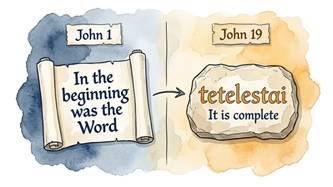
Seven words from the cross. And the sixth one is “Tetelestai” in Greek. It is finished. The word comes from teleo, meaning to bring to completion, to carry through to its intended end. It’s not a cry of exhaustion. It’s a declaration of accomplishment. The task is done. The mission is complete. Everything the father sent him to do has reached its pre-designed conclusion.
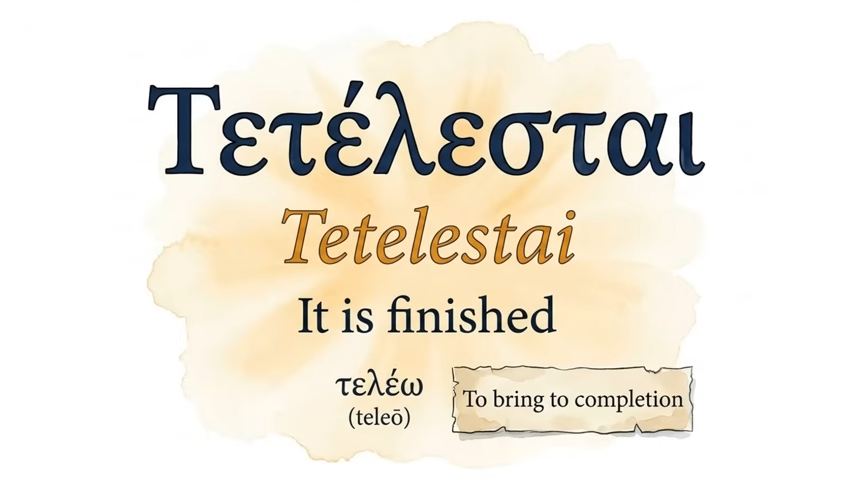
Some popular sources claim this word appeared on ancient receipts to mean paid in full. But recent scholarship calls that into question. What is not in question is what the word means in context. The work is finished. And John, who records this moment, has been building toward it from the opening of his gospel. The same author who wrote, “In the beginning was the word, now records the word’s final declaration, “Tetelestai”. It is complete.
And then the seventh and final word is an act of rest. He commits his spirit to the father. Not with a scream of defeat… with a deliberate act of trust. Do you see the pattern? Six statements of active work. The seventh is rest. Creation’s rhythm replayed on Calvary. Six days God worked. The seventh he rested. Six words Jesus spoke while the work of salvation was being accomplished. The seventh is surrender into the father’s hands. The structure of creation and the structure of redemption mirror each other.
And then, according to the gospel accounts, Jesus’ body rested in the tomb on the seventh day of the week. His body lay still on the day God had set apart for completion since the beginning of the world. The work was done. The price was paid. And on the day that always meant finished, the redeemer rested.
The entire Bible from its seven-word opening to its final vision of a world made new is the story of a God who swears oaths and keeps them. A God who does not start things he does not intend to finish. A God whose word and whose completion are in the original language the very same word. His promises are as structured as creation and they will be fulfilled with the same precision.
Visit ReclaimYourLegacy.com to hear some final thoughts to round out our discovery that the biblical meaning of seven is not mystical. It’s covenantal. It’s the biblical author’s way of saying over and over again in story after story, “This God of ours keeps his promises.”
There’s one more teaching from Jesus that belongs in this conversation. It’s in Matthew 18:21-22. Peter asks Jesus a question about forgiveness.
Lord, how often shall my brother sin against me and I forgive him? Up to seven times. Do you think Peter might have thought he’s being generous? I discovered that the rabbis of his day typically taught that forgiving someone three times was sufficient. Peter doubles it and adds one. Seven would be complete forgiveness. But Jesus’ answer dismantles the question. “I do not say to you up to seven times, but up to 70 times 7”… That’s 490… seventy 7s. That number is not random. It’s the same number Daniel received from the angel Gabriel… Seventy 7s. In Daniel, it was the timeline for the Messiah’s atoning work. In Matthew, Jesus applies it to forgiveness. The connection is striking. Now don’t miss this… The same numerical structure that governs God’s plan to deal with the sin of the world is the structure Jesus gives for how his followers should deal with each other’s failures. God’s forgiveness is not rationed. It’s as complete and as structured as his covenant promises and it follows the same sevens.
The book of Revelation takes the number seven and builds its entire architecture around it. Seven churches, seven seals, seven trumpets, seven Bowls, seven spirits before the throne of God. The number appears more than 50 times in this one book alone. No other number comes close and the structure is deliberate.
The seven churches in chapters 2 and 3 represent the full body of believers. These are real churches in real cities. But the fact that there are exactly seven of them, when there were many more churches in the first century, signals that John is presenting a complete picture. These seven stand for all. The seven seals open the scroll that reveals God’s complete plan for history. The seven trumpets announce the unfolding of that plan. The seven bowls bring it to completion. Each sequence of seven moves the narrative closer to a single destination. And what’s that? The total restoration of all things. And each sequence builds on the one before it. Like waves moving towards shore. The sevens in Revelation are not repetitive. They’re progressive. They’re moving somewhere. In Revelation 21, the vision reaches its climax. A new heaven and a new earth. God dwelling with his people. No more death, no more pain, no more separation. And a voice from the throne says, “It is done.” Revelation 21:6. The same declaration from the cross now spoken over all of creation. Finished, complete, the oath fulfilled. The Bible begins with a seven-word sentence and ends with a world made new. And between those two end points, the number seven keeps appearing at every moment of covenant, completion, and divine faithfulness, carrying the same message. God keeps his word.
You’ve probably had an experience where you’ve prayed and prayed for the answer you’re seeking… and it seemed like your prayers were bouncing off the ceiling. Waiting on God for answers to our prayers can be one of the most difficult things in our life. It’s the place where we identify with that verse in Psalm 23… “though I walk through the valley of the shadow of death…” And that’s where we have to lean into our total dependency on Him… Our declaration? “I will fear no evil… for YOU are with me…” And through our tears, we declare … “Your rod and Your staff… they comfort me.” The rod in Scripture is often used to describe chastening, correction, even penalty. Nobody says enduring those things is easy. But the staff messages the gentle guidance of the loving shepherd to aim his sheep in the right direction. And where does that lead? Keep reading the passage. “You prepare a table before me in the presence of my enemies; You anoint my head with oil; my cup runs over.” Even in the midst of battles … for the one who abides in Jesus and His word… our brave confession is true and sure… “Surely goodness and mercy shall follow me all the days of my life; and I will dwell in the house of the Lord forever.”
God has not forgotten you. He’s working behind the scenes, even when we can’t see it. That’s the testimony of seven in scripture. It’s not that everything is resolved according to our timeline. But surely, God’s timeline has a structure, and that structure aims toward completion. The thread you cannot see is still being woven by God’s Holy Spirit into the tapestry of God’s purpose for your life.
So, what does this mean for how you live? The number seven in the Bible is not a code to crack. It’s not a formula for predicting the future, or a system for unlocking hidden messages. The meaning of seven is not mystical. It’s not numerology. It’s covenantal. It’s the biblical author’s way, under the guidance of God’s spirit, of saying over and over in story after story, “The Most High God keeps his promises.”
Every time seven appears in a biblical narrative, it’s pointing to the same reality. God finishes what he starts. His promises are not proposals. They are oaths, bound by his own character, sealed by the same word that means both seven and to swear an oath. And that changes how you read the Bible. When you see seven days at Jericho, you’re not reading a random military timeline. You’re watching a covenant reach its conclusion. When you see seven feasts, you’re looking at a calendar of divine appointments that have been and are being kept to the day. When you hear Jesus say Tetelestai as the sixth word from the cross, and then rest on the seventh day, you’re witnessing creation’s rhythm woven into the climax of redemption.
If you’re in a season right now where something feels incomplete, where healing has not come, where the answer is still silent, where the wall hasn’t fallen, the testimony of scripture is that the God who structured creation around the rhythm of completion has not lost track of your story. The seventh day is coming. The work will be finished. Not because you’ve earned it, but because the one who promised it has bound himself to it with an oath.
Philippians 1:6 reminds us of a heavenly promise: “being confident of this very thing, that He who has begun a good work in you will complete it until the day of Jesus Christ.”

And if Naaman’s story teaches anything, it’s this. Do not walk away before the seventh dip. The sixth looked exactly like the first five. Nothing had changed. But completion was one step away. The difference between six and seven is the difference between not yet and done. And only God knows which step you are on.
The entire Bible from its seven-word opening to its final vision of a world made new is the story of a God who swears oaths and keeps them. A God who does not start things he does not intend to finish. A God whose word and whose completion are in the original language the very same word. His promises are as structured as creation and they will be fulfilled with the same precision.
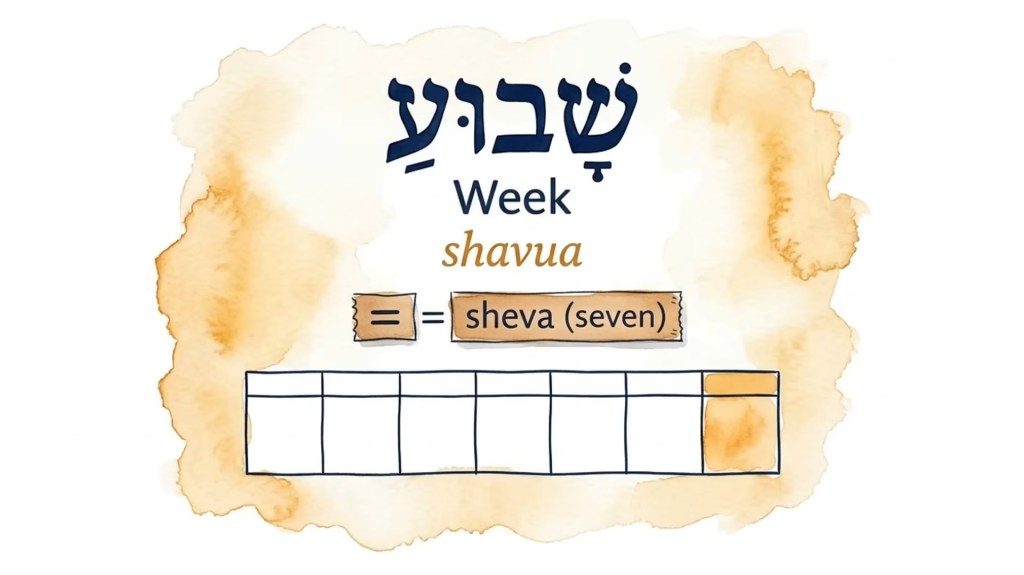
One last thought. The Hebrew word for week – sha’vua – comes from the same root as sheva. Every single week that passes is, in Hebrew, a seven. Which means every time the seventh day comes around, the language itself is reminding you God finishes what he starts. The rhythm of your week is built on the same foundation as the rhythm of scripture. You do not have to go looking for the number seven. It finds you. Every seven days, the same word that means oath and completion and satisfaction rolls back around and says, “He is faithful. He has always been faithful and he is not done yet.
Thank the Lord for this uplifting content, I discovered at a new online channel called Deep Made Simple. The link in below directs to their channel, where you can find more interesting topics, created with equally careful research.
Source: Why Every Bible Story Hides the Same Number (And What It Means) https://youtu.be/68iyWGvJoGc?si=yDl1JrG741_NHlel Deep Made Simple